Blog2Video vs Seedance
Seedance is priced like a generation model. Blog2Video is built like video infrastructure.
The key difference is not just output style. It is the underlying economics. Seedance charges per generated clip, while Blog2Video's Remotion-based approach turns templates into renderable video assets with compute costs that stay extremely low.
The core difference: generation model vs programmatic rendering
Seedance is an AI video generation model. You describe the output you want, then the system generates clips. That is useful when the value comes from producing net-new photorealistic or model-generated visuals from prompts.
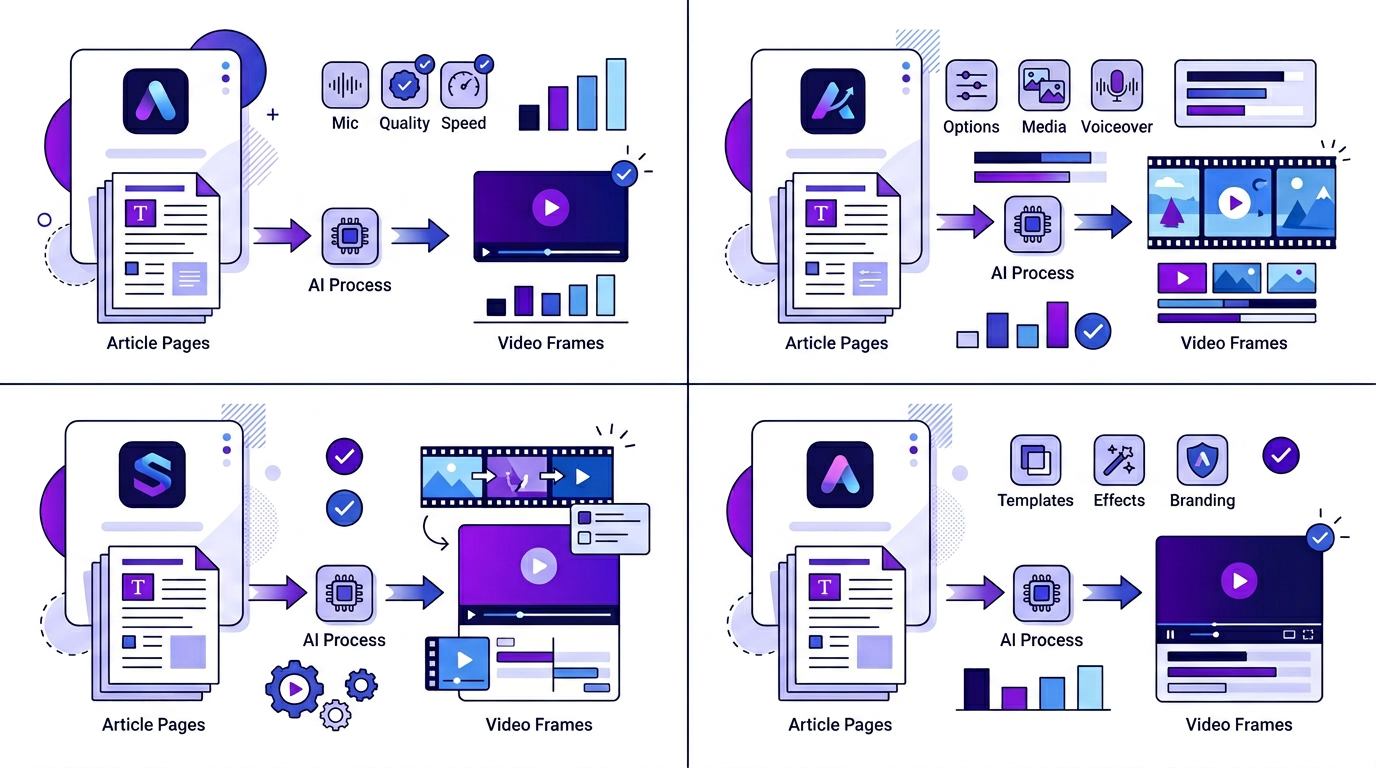
Blog2Video solves a different problem. It is designed for turning structured written content into repeatable videos using templates, scenes, narration, and programmatic rendering. Under the hood, that means a Remotion-based workflow rather than paying a generative model fee every time a user wants another five-second clip.
- Seedance: prompt-led video generation priced by clip output
- Blog2Video: template-led video generation priced like rendering infrastructure
- Seedance: stronger for model-generated visuals and open-ended generative output
- Blog2Video: stronger for structured explainers, branded templates, and repeated content production
Why the economics diverge so much
Based on the pricing snapshot you shared, direct Seedance 2.0 pricing ranges from 20 credits for a 5-second 480p clip to 90 credits for a 5-second 1080p clip. For a five-minute video, you need sixty 5-second generations. That means roughly 1,200 credits at 480p, 2,400 credits at 720p, or 5,400 credits at 1080p.
The same snapshot shows one-time credit packs such as 500 credits for $4.99, 1,000 for $9.99, 2,500 for $24.99, and 5,000 for $49.99, along with subscription plans like 3,000 credits for $19.9/month, 8,000 credits for $39.9/month, and 15,000 credits for $69.9/month. In practice, that means long-form video generation can get expensive very quickly if every segment is billed like a fresh AI generation job.
- 5-minute video in 5-second Seedance clips = 60 generations
- Estimated direct credit consumption: 1,200 to 5,400 credits depending on resolution
- Subscription cost scales with how often you need long-form output
- Per-video margins stay under pressure because generation cost repeats every time
What the API pricing implies
Via the fal.ai API, the pricing snapshot you provided shows about $0.18 for a 5-second 720p Seedance clip. Multiply that across sixty clips and the cost lands around $10.80 for a five-minute video at that clip rate. Your supplied comparison framed the rough API expectation at around $18 for a five-minute 720p video, which makes the broader point clearly: model-priced generation stays expensive once you move beyond short clips.
That is the main business issue for any templated video product. If the platform has to pay model rates every time a user generates a longer video, the cost basis remains high on every single render. The operator either eats the margin loss or passes those costs through to the user.
Why Remotion-based video is different
Remotion is not a text-to-video model. It is a framework for building video compositions in React and rendering them programmatically. According to the pricing information you shared, Remotion is free for individuals and companies up to three people. For larger commercial teams, the cost moves to licenses such as a Creators seat at $25 per seat per month or an Automators plan at $0.01 per render with a $100 monthly minimum.
Once the template system exists, the render costs are tiny. Based on the same pricing snapshot, a one-minute video render can cost roughly $0.017 in AWS Lambda compute and a ten-minute HD render roughly $0.10. For a five-minute video, the estimate comes out around $0.05 in rendering cost. That is a completely different economic profile from paying dollars per clip to a generative video model.
- Upfront effort goes into building templates, not paying generation fees forever
- Per-render compute stays extremely low after the system is set up
- Works especially well for repeated branded outputs at scale
- Turns video generation into software infrastructure rather than clip-by-clip AI spend
Where Seedance is still the better fit
Seedance makes sense when you specifically want model-generated visuals and the value comes from visual novelty. If you need a short cinematic asset, prompt-led experimental video, or a one-off AI-generated visual sequence, paying a higher per-generation cost can still be worth it.
That is especially true when the goal is not repeatability. If each video is a separate creative experiment and the visuals need to be invented fresh each time, a generation model can be the right tool even if the economics are less attractive for long-form production.
Why Blog2Video is the stronger fit for structured content businesses
Blog2Video is built for a different category of work: turning blog posts, docs, explainers, launch notes, and educational content into reusable video formats. In that kind of system, the real leverage comes from building the template once, then using it across many pieces of content at very low render cost.
That is why the economics matter so much. For blog2video.app's use case, a Remotion-based system is not just cheaper in theory. It is structurally better aligned with the product. The upfront work goes into themes, scene layouts, brand systems, and content logic. After that, each new video render costs almost nothing compared with model-priced generation. That makes pricing, margins, and scaling much more sustainable.
- Better for branded templates and repeatable scene systems
- Better for explainers, tutorials, and written-content repurposing
- Better for operators who need predictable cost per render
- Better when the business depends on many videos rather than one-off experiments
Which one should you choose?
Choose Seedance if you need AI-generated visual output and are comfortable paying model-level prices for each clip or each long-form sequence. Choose Blog2Video if you need a scalable system for converting structured content into video repeatedly without letting generation costs dominate the business.
The decision is less about whether one tool is universally better and more about what kind of engine you need. Seedance is a generation model. Blog2Video is a content-to-video workflow built on rendering infrastructure. For templated, branded, repeatable video generation, that difference is decisive.
Frequently Asked Questions
Is Seedance cheaper than Blog2Video for long videos?
Based on the pricing snapshot you shared, no. Seedance can become significantly more expensive for longer videos because the cost compounds across many five-second generations, while a Remotion-based render stays extremely cheap once the template system exists.
Why is Blog2Video cheaper to operate than a generative video model?
Because Blog2Video relies on programmatic rendering rather than paying a model-generation fee for every clip. The major investment is in building the templates and workflow, then the ongoing per-render compute cost stays low.
When would someone choose Seedance over Blog2Video?
When the main goal is generating new AI visuals from prompts rather than turning structured written content into a repeatable branded video. Seedance is more suited to open-ended generative output than templated explainer production.
What kind of product benefits most from Blog2Video's Remotion-based approach?
Products that turn blogs, docs, tutorials, launch notes, or other structured content into videos repeatedly. The more often the workflow runs, the more valuable the low render cost and reusable template system become.