Growth playbook
Your Substack can be a media empire. Most writers treat it like a hobby.
Finance writers, policy analysts, political commentators — Substack is yours to own. Here's the 2026 playbook for growing your list, picking the right niche, launching a YouTube channel to amplify it, and using Blog2Video's designer templates to make every post look and feel like a broadcast.
Why most Substack newsletters stall — and what actually moves the needle in 2026
Substack crossed 50,000 paid creators in late 2025. At least 50 of them now earn over $1 million per year. The platform is real, the money is real, and the audience is there.
But the writers who stall share a pattern: they publish inconsistently, treat every platform as a separate job, and never find a sharp enough niche for readers to feel they need the newsletter specifically — not just newsletters in general.
In 2026, 40% of all new Substack subscriptions come from inside the Substack network itself, through the Recommendations feature and Substack Notes. That number has quietly made Substack the most self-contained discovery engine in independent media. If you're not using Notes and Recommendations as your primary growth engine, you are leaving most of your potential audience on the table.
The writers who grow — fast — do three things differently: they pick a niche with urgency and buying intent, they show up in Notes every single day, and they build a content loop that pulls readers from everywhere else into one place.
Pick your niche: the categories that grow fastest on Substack
Niche selection is not about being narrow for its own sake. It's about being specific enough that a reader immediately recognizes you as the person who covers this — and broad enough that your addressable audience is large enough to grow. Here's how the highest-velocity niches break down.
- Finance & Markets: Readers here have high buying intent and will pay for an edge. The strongest newsletters combine original research, trade ideas, and macro analysis with a point of view the reader can't get from financial media. Topics that perform: FX and equities, earnings breakdowns, dividend investing (Buffett-style frameworks are consistently popular), and US fiscal policy. The Bloomberg Terminal aesthetic — amber text on dark canvas, data-dense but calm — matches what finance readers associate with authority.
- Politics & Political Analysis: The political Substack space is large and growing. The top newsletters — The Bulwark, The Free Press — succeed because they take a clear stance and defend it rigorously. Cross-platform partnerships tied to election cycles and premium subscriber-only series have driven 18% paid conversion rate lifts for top political writers. Video town halls (subscriber-exclusive, weekly) have also proven powerful: Jim Acosta's weekly video format led to 20% growth in his paid tier within six months.
- Public Policy & Research: Data-driven policy writing is underserved and high-trust. Readers include researchers, think-tank staff, journalists, and staffers who actually pay for sharp analysis. Content syndication works especially well here — Cathy Young's free speech series was syndicated across two major digital outlets and drove a 15% subscriber spike in a single month. Pair detailed policy breakdowns with a clear narrative voice and your newsletter becomes a citation source.
- Personal Finance: Personal finance never goes out of style. The format that works best is step-by-step, example-driven, and jargon-light. Readers share these newsletters because the advice is immediately actionable. Positioning matters: 'money for people who hate spreadsheets' lands differently than 'personal finance tips.'
- Investing & Wealth Research: Long-form, research-heavy issues on specific sectors — AI, defense, biotech, energy transition — attract readers who treat the newsletter like a research service. These readers convert to paid at higher rates than any other category.
The four pillars of Substack growth in 2026
Strategy one is Substack Notes. Twenty minutes a day. Write one or two Notes — short, punchy observations tied to your niche — and engage with three to five other writers in your space. Notes is the platform's internal discovery surface, and consistent use compounds over weeks, not days. This is your highest-leverage free action.
Strategy two is cross-promotions and Recommendations. Individual newsletter swaps — where you recommend a peer and they recommend you — consistently generate 50 to 100 new subscribers per activation for newsletters in the 1,000–10,000 subscriber range. The key is finding writers at a similar growth stage in adjacent niches. A finance writer and a personal finance writer cross-promoting each other serves both audiences without cannibalizing either.
This works even better within finance itself when the newsletters cover different angles on the same scale. A macro newsletter, an earnings-focused newsletter, and a dividend-investing newsletter at the same subscriber tier rarely compete for the same read — a reader can subscribe to all three without redundancy. Pair up with two or three finance writers at your scale, set a monthly Recommendation swap and a joint Notes thread reacting to the same earnings print or Fed decision, and you are effectively running a shared distribution desk without splitting revenue or merging mastheads.
Strategy three is consistency over frequency. One issue per week is the standard most fast-growing newsletters use in their first year. Publishing every Tuesday beats publishing three times one week and nothing the next. Readers set expectations, and broken expectations cost subscribers. Pick a day, hold it.
Strategy four is sequencing your paid tier correctly. Add paid subscriptions only after you reach 3,000 to 5,000 free subscribers. Before that point, your energy is better spent growing the free list. After it, your conversion math starts working: even a 5% conversion at 5,000 free subscribers is 250 paying readers — at $10/month, that's $2,500 monthly recurring revenue before you've done a single paid campaign.
The option most Substack writers overlook: launch a YouTube channel
In 2026, the most successful writer-creators run YouTube and Substack as a single integrated system — not as two separate jobs.
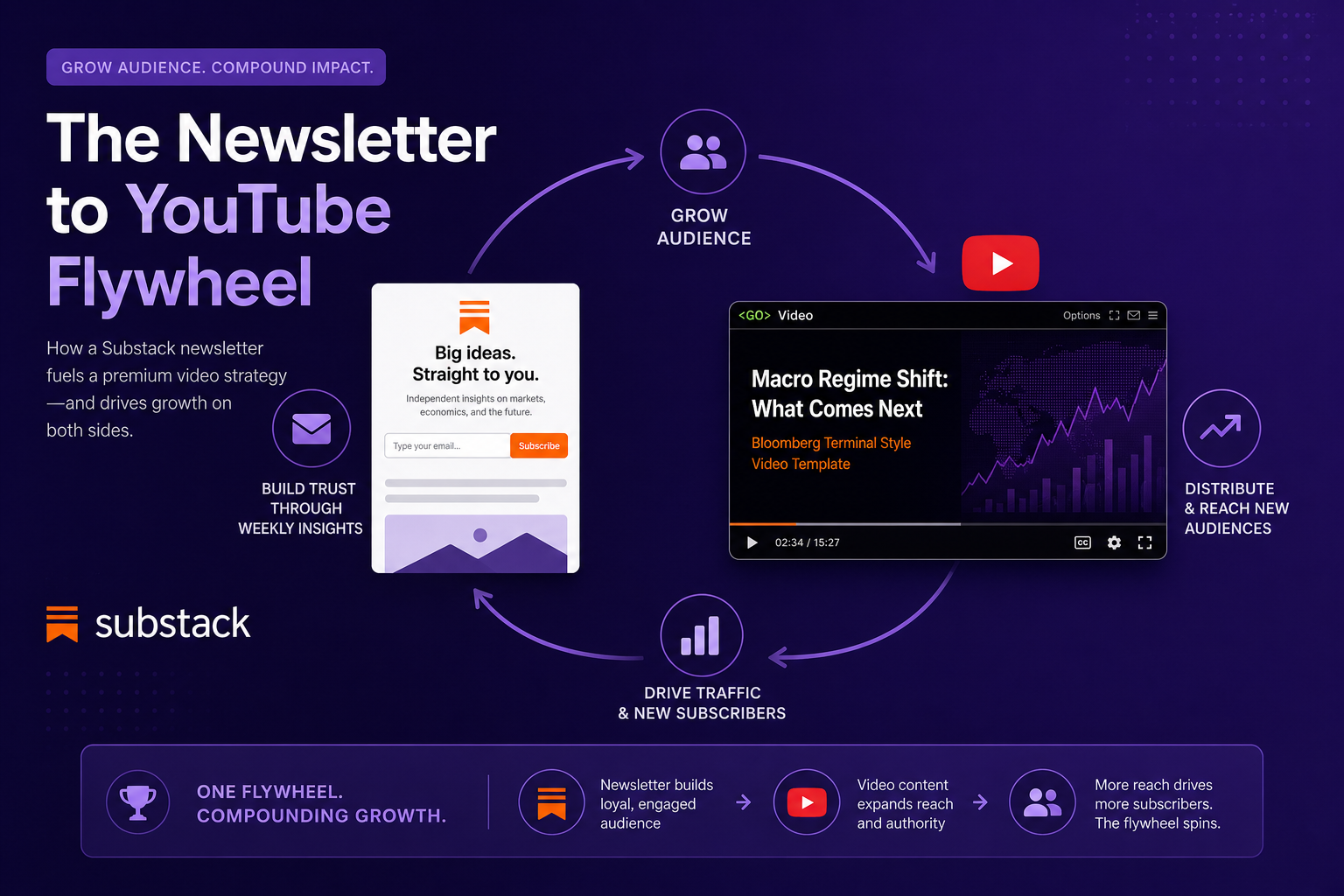
Here's how the flywheel works: YouTube brings in new readers through search and the recommendation algorithm (YouTube's discovery is enormously powerful for niche topics). Your best YouTube viewers — the ones who watch more than 70% of a video — are exactly the readers who will subscribe to your Substack for more depth. Substack then converts that warm traffic into paid subscribers at $5–$10/month. YouTube earns ad revenue. Substack earns subscription revenue. Both grow the other.
The content doesn't need to be rebuilt from scratch. Your newsletter is already the script. A 1,200-word Substack issue translates into a six-to-eight minute YouTube video almost word for word. Finance writers can break down a trade thesis on camera. Policy writers can do a desk breakdown of a new bill. Political commentators can react to breaking news with the depth that YouTube's algorithm rewards.
From one newsletter issue, you can produce: a full YouTube video, three to five YouTube Shorts, clip-length versions for LinkedIn and X, and PNG slides for a LinkedIn carousel — all without writing anything new. That is not content repurposing. That is a distribution system.
The new insight: Blog2Video turns your Substack posts into YouTube-ready videos
Here is where the workflow changes entirely.
Blog2Video was built for exactly this use case: you have a blog, a newsletter issue, or a policy brief — and you need it on video without rebuilding the narrative from scratch. Paste the URL or text, and Blog2Video structures it into scenes, generates voiceover, picks visuals, and produces a video you can upload to YouTube within minutes.
But the part most writers miss is the designer templates. Blog2Video's templates are not generic slideshow presets. They are niche-matched visual identities built to make your content feel authoritative on screen, not like a Canva export.
The Bloomberg Terminal template was designed specifically for finance writers. Amber text on a dark canvas, a live ticker rail, monospaced precision — it mirrors the aesthetic finance readers associate with serious market analysis. If you're writing about earnings, rates, fiscal policy, or macro, this template tells viewers in the first two seconds that you know what you're talking about.
The Chronicle template was built for long-form narratives: cream backgrounds, tall serif type, illuminated drop caps, ornamental borders, and chapter-like pacing. Policy writers, political historians, and research-heavy journalists will recognize the register immediately. It's the difference between looking like a blog post and looking like a piece of long-form journalism.
Beyond these two, Blog2Video's template library spans explainer-style, news-anchor, minimalist, bold editorial, and data-heavy formats — so whether you write about personal finance, geopolitics, or market structure, there is a visual identity that matches the tone of your writing.
And the exports close the loop. Download as MP4 for YouTube. Export individual PNG scenes for a LinkedIn carousel. Save as PDF for newsletter embeds or media kits. Use the iframe embed to drop the video directly into a Substack post — no third-party upload required. Your YouTube launch does not add hours to your workflow. It adds a single step at the end of writing.
The distribution loop: one issue, every channel
Here is what the full system looks like for a finance writer publishing once a week:
Write your newsletter issue on Tuesday. It goes out to your Substack list as normal. Paste the URL into Blog2Video — select the Bloomberg Terminal template for the authority aesthetic — and generate the video. Upload the MP4 to YouTube with your newsletter issue title as the video title. Cut three Shorts from the generated scenes. Export PNG slides for a LinkedIn carousel post. Embed the video back into the Substack issue via iframe so your email subscribers can watch it inline.
You published once. You distributed six times across four channels. Every piece traces back to the original writing. Nothing was rebuilt from scratch.
For politics writers, the Chronicle or editorial template gives the same gravitas on screen that your prose already has on the page. For public policy researchers, the clean data-heavy templates let charts and citations carry the visual weight — matching the credibility your readers already associate with your work.
This is how Substack writers scale without hiring a team. The writing is already done. The distribution just needs a system.
- Finance writers: Bloomberg Terminal template for terminal-grade market authority
- Politics writers: Chronicle or bold editorial templates for narrative weight
- Public policy: data-heavy and clean templates that let the research speak
- Personal finance: explainer and friendly templates for step-by-step walkthroughs
- Investing research: news-anchor and structured templates for deep-dive credibility
Start with the writing you already have
You don't need a video team. You don't need a studio. You need a sharp niche, a publishing rhythm, and a system that turns every newsletter issue into a cross-platform asset.
Blog2Video handles the video side of that system. Your Bloomberg Terminal walkthrough of this week's earnings, your Chronicle-style policy breakdown, your explainer on why rates matter for dividend stocks — all of it is a YouTube video waiting to happen.
Try it with your last newsletter issue. Paste the URL, pick the template that matches your niche, and see what your writing looks like on screen.
The general Substack growth playbook
This guide is about growing with YouTube and video. For the fundamentals that apply to every Substack (recommendations, Notes, cross posts and directories), BlogHub has a full guide on how to grow on Substack.
Frequently Asked Questions
How many subscribers do I need before I launch a YouTube channel alongside my Substack?
There is no required threshold. Many writers launch both simultaneously because YouTube search traffic builds the Substack list faster than Substack alone. If you already have 500 or more free subscribers, you have enough proof-of-niche to start a YouTube channel with confidence. The content is the same either way — YouTube just gives it a second distribution path.
Which niches grow fastest on Substack in 2026?
Finance, investing research, politics, and public policy consistently show strong subscriber growth and paid conversion on Substack. Personal finance performs well for virality and sharing. The common factor across all of them is a sharp point of view: readers subscribe to you specifically, not to the topic in general.
How does Blog2Video help Substack writers specifically?
Blog2Video converts your newsletter issues into structured video scenes with voiceover, visuals, and designer templates matched to your niche — Bloomberg Terminal for finance, Chronicle for long-form narratives, editorial and explainer formats for everything else. You export the video for YouTube, cut Shorts from the scenes, and embed the result back into Substack via iframe — all from the same source content.
What is the Bloomberg Terminal template and who is it for?
The Bloomberg Terminal template is a Blog2Video designer template that mimics the iconic trading-terminal aesthetic: amber text on a dark canvas, monospaced precision, and a ticker rail. It was built specifically for finance writers covering earnings, rates, macro, and market structure — audiences that associate this visual register with credibility and authority.
How do I turn a Substack issue into a YouTube video without a production team?
Paste the Substack post URL into Blog2Video. The tool structures the content into video scenes, generates narration, and adds visuals. Pick a designer template that matches your niche, download the MP4, and upload it to YouTube. The full process from post to uploaded video takes under 15 minutes for most newsletter-length content.
When should I add paid subscriptions to my Substack?
Most growth research points to 3,000–5,000 free subscribers as the right time to introduce paid tiers. Before that, focus on building the free list through Notes, cross-promotions, and your YouTube channel. After that threshold, even a 5% conversion rate generates meaningful recurring revenue.